Step off the plane and breathe easy. You’ll move through Ngurah Rai International (DPS) with a few clear steps: a digital arrival QR, visa checks, immigration, baggage and customs. Keep calm and aim for speed—clearing admin fast makes the rest of your trip smoother.
We’ll give you a simple, phone-ready flow so you know what to do first, what to skip, and what to screenshot. Expect long walks, occasional queue surges and slow luggage. You’ll also meet transport touts; stick to the official lanes and avoid paid helpers.
This short checklist points to official processes and practical tips to speed your entry. Follow the steps and you’ll turn a crowded arrival into a calm start to your travel experience. ✈️
Key Takeaways
- Expect QR form, visa checks and immigration on arrival.
- Move with purpose: quick steps reduce crowd stress.
- Keep documents and screenshots ready on your phone.
- Avoid unofficial helpers; use official counters and signs.
- Pack patience for long walks and slow luggage.
Before you fly from Australia: what to sort out for arriving Bali
Before you board, sort the essentials so entry runs smoothly and stress-free. Do this the day before departure to avoid last-minute panic. A tidy checklist is the simplest travel hack. ✈️
Passport checks Aussies often miss
Make sure your passport has at least six months validity and one blank page. Officials can refuse entry if your passport is water-damaged, torn or in poor condition.
Travel insurance and onward proof
Travel insurance that covers medical costs and trip disruption is strongly recommended. Immigration may ask for your boarding pass or proof of onward travel and accommodation. Keep PDFs or screenshots ready.
Keep key documents accessible
Use a passport wallet and an “airport folder” on your phone. Store screenshots, booking references and PDFs together. Make sure your phone is charged before landing or carry a power bank—QR codes and forms matter now.
| Item | Why it matters | Quick tip |
|---|---|---|
| Passport | Validity, condition and blank pages are checked | Check expiry and pages one week before travel |
| Boarding pass | May be requested at check-in or entry | Keep screenshot + live app copy |
| Travel insurance | Covers medical and cancellations | Save policy PDF to phone |
| Onward booking | Proof of exit can be asked | Print or screenshot your reservation |
Complete the All Indonesia Arrival Card within 72 days
Do the mandatory digital card in the 72 hours before travel — it’s quick and avoids surprises. The All Indonesia Arrival Card is the single form that now handles immigration details, customs declaration and health declaration in one go.
How long it takes: set aside about 2–3 minutes if you have your passport, flight and accommodation details ready. The form is free and sends a QR code to your email.
What happens next
After submission you’ll receive a QR code by email. That QR is scanned at immigration and customs as your proof of entry.
Store the QR safely
- Screenshot the QR and save to your camera roll.
- Email the image to yourself and keep an offline copy.
- Print one page if you prefer paper backup.
Use only the official website
Beware of paid services and sponsored ads that mimic the official website. These sites may charge fees or harvest personal information.
Quick tips: double-check spellings before you submit. Small typos can cost you precious time at the counter. Stay calm, be prepared and you’ll move through much faster. ✨
Visa arrival options for Australians at Ngurah Rai International Airport
Choosing the right visa can save you time and hassle when you land at Ngurah Rai International. Pick the option that matches your trip length and you’ll avoid extra queues and surprises. ✨
Visa Exemption vs Visa on Arrival
Visa Exemption Arrangement (VEA) usually lets you stay 30 days and cannot be extended. It’s the simplest path if your trip is short.
Visa on Arrival (VOA) is valid 30 days and can be renewed once, for a total of up to 60 days. Use VOA when you need more flexibility than the exemption allows.
e-VOA: when to apply and why it helps
Apply online up to 14 days before travel, and no later than 48 hours before your flight. An e-VOA cuts queue time and usually sends you straight to the immigration counters or e-gates.
What happens when you land
If you have VOA paperwork still to do, stop at the visa desk first, then join immigration. If you hold an approved e-VOA, head direct to the immigration lane or e-gate indicated.
- Decide early: short trips = VEA; longer stays = VOA.
- e-VOA saves time at busy international airport peaks.
- Officers keep final say — keep documents tidy and calm.
Quick prompt: if you plan to extend, keep boarding passes and booking confirmations handy. It helps if officers ask about your intended length of stay and onward travel.
Pay the tourist levy without getting ripped off
Don’t let a tourist fee slow you down — know what it is and how to pay.
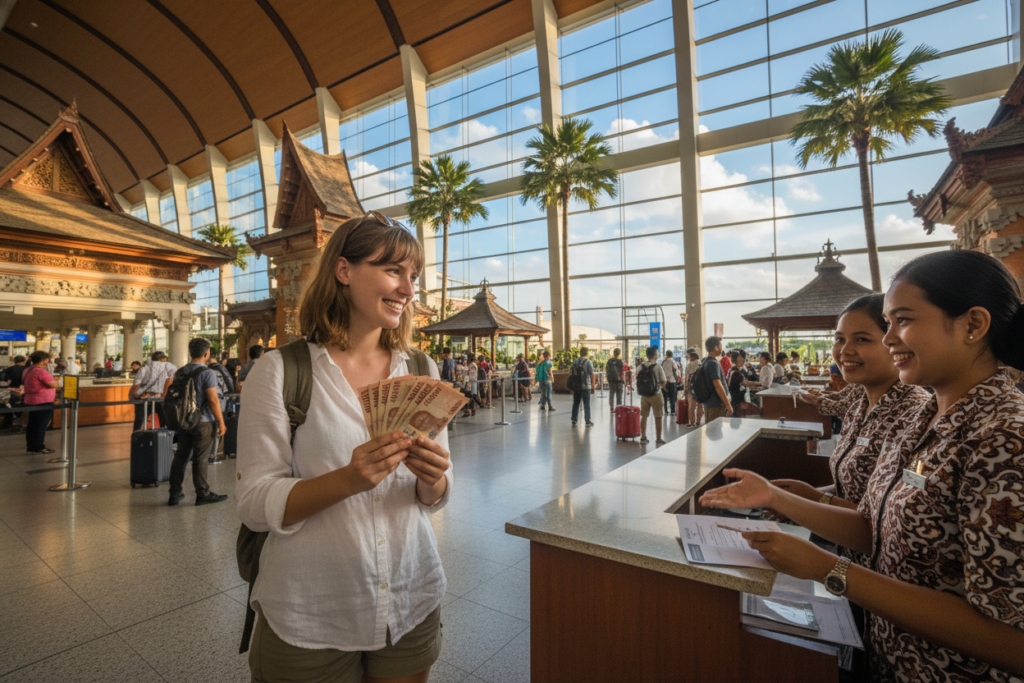
The bali tourist levy is a provincial fee charged to international visitors. It’s separate from visas and helps local services. The current cost is IDR 150,000 per person, so couples and families can budget clearly.
Online vs on-site: what to expect
Paying online is faster and gives you digital proof. That can shave minutes off your time in the terminal and reduce stress during busy arrival periods.
Paying on arrival works, but expect queues and possible extra processing. Keep your receipt ready and save a screenshot.
Spot fake pages and misleading ads
Only use the official website payment channel. Check the URL for correct spelling and a secure padlock. Avoid pages that add surprise service charges or use countdown timers to rush you.
- Ignore “sponsored” ads that mimic official pages.
- Don’t enter card details on unclear payment portals.
- Save proof of payment offline with your other travel QR codes.
Quick tip: handle the levy before you land if you can — less admin at the airport equals more time to enjoy your trip. ✨
Landing at DPS: getting off the plane and moving fast
Once the plane doors open, small choices — like the loo or heading straight to immigration — decide how fast you move.
Toilets on arrival vs your best time-saving strategy
Best move: use the toilet on the plane if you can. That saves minutes when queues swell.
There are flush, family‑suitable toilets in the transit corridors before immigration. They exist, but each stop often means more people ahead of you.
Long walks, bus gates and staying ahead
Ngurah Rai has long corridors, large halls and occasional bus transfers from remote gates. These create surge moments.
“Walk with purpose, keep docs handy and avoid bottlenecks if you can.”
You don’t need to sprint. Move smart, keep your QR and passport accessible and pass through steadily.
| Moment | What to expect | Quick action |
|---|---|---|
| Off the plane | Signs, jet bridge, staff directions | Keep passport ready; head direct |
| Transit corridor | Toilets available but busy | Use only if essential |
| Bus gates | Short ride, then walking | Stay near family, move early |
Final tip: balance speed with family needs. A calm, focused move saves time and makes the whole arrival experience smoother. ✨
Immigration at Bali Airport: queues, e-gates and priority lanes
Queues change fast in the immigration hall, so a quick plan beats panic. Walk the signage and pick the shortest visible lane. Larger flight waves form the longest lines near main counters.
What officers may ask for
Make sure your QR code from the digital arrival card, passport and boarding pass are ready. Open your passport to the photo page and hold papers where officers can see them without digging.
Families and elderly lanes
Priority lanes usually exist for children under five and travellers over 60. Check overhead signs — locations shift with traffic. If you travel with little ones or an older adult, head to the assistance queue; it often moves faster.
Fast Track reality check
Official fast-track lanes are for diplomats, official business or prepaid services by recognised operators. Avoid street sellers offering “skip the line” passes — they’re usually unauthorised and risky.
Wait times and practical tips
Expect anything from under an hour to 2+ hours depending on how many flights land together. If you have an e‑visa that supports e‑gates, use it. Stay calm, be polite and follow officer directions — attitude helps the process run smoother.
Baggage claim: what to expect when your luggage takes ages
Your bags can trail the plane by a good twenty minutes or more — use the pause wisely. Expect ~20 minutes as very fast; up to an hour is common at this terminal. Stay calm: slow luggage is normal and not your fault.
How to match your flight to the right carousel
Check the flight number on the overhead screens and match it to the carousel number. Screens can change mid‑wait, so stay close to the information board until you’re sure.
Oversize and heavy items
Surfboards, heavy gear and odd‑shaped bags often appear at the entry end of the carousel, not the usual exit point. Watch both ends and ask staff if you don’t see your oversized item.
Use the downtime smartly
Now that immigration is behind you, take a quick toilet break and sort documents. Screenshot QR codes, keep levy proof ready and pull up transport details.
- Smart spot: stand near the info screens until your belt is confirmed.
- Keep tags: keep luggage tags handy in case staff need a quick check.
- Don’t wander off: you’ll miss changes if you roam too far.
If you want more detailed arrival information, see arriving at DPS. ✈️
Duty-free inside the terminal: when it’s worth buying alcohol
Buying spirits at the terminal can save you cash — but only if you know where the store is and what limits apply. Think of this as a quick money check before you head into town. 🍸
Where to find the real duty-free
The legitimate duty-free sits inside the secure arrivals flow — after immigration and before customs. At the bali airport this is the only official shop selling tax-free liquor inside the terminal.
Allowances and simple requirements
Rule of thumb: most travellers are limited to one bottle (about 1 litre) per person. Stick to that and you’ll avoid hassle.
If you exceed the limit and get selected for inspection, extra bottles can be confiscated by customs. Be mindful and plan purchases with companions so you split allowances, not risk losses.
| Brand | Approx price (IDR) | Value note |
|---|---|---|
| Smirnoff | IDR 330,000 | Good basic value |
| Grey Goose | IDR 750,000 | Premium; stock varies |
| Johnnie Walker Red Label | IDR 550,000 | Popular mid-range pick |
Quick tip: if you’re tight on space, ask yourself which things are worth a single-bottle allowance. A calm choice saves you time at customs and keeps your travel start smooth.
Customs and screening: using your QR code and getting through smoothly
Customs is the final official check after baggage. Have the digital declaration ready and be prepared to present the QR outcome from the All Indonesia Arrival Card.
What to show and the handoff moment
After you collect luggage, approach the customs desk and present the printed or saved form output. Officers scan the outcome of your electronic customs process and decide if you can pass straight through.
X-ray, bag checks and how selection works
Some travellers are waved through. Others get directed to an X-ray lane or a manual inspection.
Keep it painless: pack so you can open bags quickly, separate new boxed items, and put liquids and electronics where they’re easy to access.
Cash and goods limits to know
Common thresholds heard at the terminal: cash above 100 million IDR must be declared. Personal goods allowance is usually around USD 500 per person.
If you’re assessed duty
Receipts make value checks faster. Keep originals and phone copies in separate places (wallet + cloud screenshot).
“Personal use” means items that look used — a laptop with stickers or a camera with a strap. Multiple sealed, boxed electronics can trigger questions.
“Be calm and polite — a friendly approach often shortens checks, especially when you’re tired.”
- Have the electronic customs output ready before you join the line.
- Organise receipts so a quick check proves value.
- Follow officer directions promptly; it speeds your entry.
| Stage | What happens | Quick action |
|---|---|---|
| Customs desk | Scan of electronic customs form and decision | Have form ready; show passport |
| X-ray / inspection | Selected bags or random checks | Open bag, present receipts |
| Duty assessment | Officer values items and may charge | Show receipts; stay calm and courteous |
Need extra practical tips? See our practical tips to speed your process and ease the final steps to entry. 😊
Money matters on arrival: ATMs, currency exchange and having IDR ready
One of the smartest arrival moves is to get local cash before you head into town. It gives you options for transport, food and small purchases without fuss. Having IDR on hand prevents awkward negotiating when you’re tired.
Why ATMs are a good first stop
After customs there are multiple ATMs run by major local banks. These machines sit in a secure corridor and are a fast, safe way to get cash. Withdrawing usually gives a better overall rate if your card fees are low.
Using money changers safely
Reputable money changers are nearby and convenient. Currency exchange at the terminal often has slightly higher rates, but the convenience can be worth it for immediate needs. Check the posted rate and count notes before you leave the counter.
How much IDR to take out
A practical approach is to get enough IDR for the first two days — transport, snacks and small purchases. Don’t over‑carry cash. Split notes: keep small bills handy and stash the rest securely.
- Use well‑lit ATMs and cover your PIN.
- Compare a cash withdrawal vs currency exchange based on card fees.
- Having a little cash helps you avoid costly mistakes when you’re jet‑lagged.
SIM card and connectivity at DPS: get online fast
Getting online as soon as you land makes the first hour so much easier. Quick data helps you confirm driver details, open maps and check bookings without stress.
Free WiFi basics
The public network named NgurahRai is open and needs no password. It’s handy for a fast check-in, but speeds drop when the terminal is busy.
Tip: use Wi‑Fi to message your driver, then switch to mobile data for stable navigation.
Best local pick and kiosk hours
Telkomsel is the most reliable choice for coverage and speed. A common package is about IDR120k for ~20GB with 30 days expiry — great value for short stays.
Kiosks for Telkomsel and XL usually run roughly 7:00am–2:00am, so plan if you land very late or very early.
eSIM vs physical SIM
- eSIM — instant activation, perfect if your phone supports it and you need data right away.
- Physical SIM — better if you stay longer or want face‑to‑face help and local top‑ups.
“Activate data first, then WhatsApp your driver or hotel while you’re still in the terminal.”
Quick warning: ask what a bundle includes. Some plans split total data and app‑specific allowances, so get clear information before you pay. These practical tips will save you time and headaches. 😊
Leaving the arrivals hall: airport transfers, taxis and avoiding touts
After a long plane trip, the pickup area can look intense. Lots of signs, lots of voices, and people holding name cards create a noisy scene. Pause, breathe and scan the crowd before you move.
Navigating the driver “wall”
The so‑called driver wall is a line of hosts and drivers just outside customs. Ignore anyone who hustles you or asks you to follow them. If you didn’t book it, don’t go with them.
Private transfer: lowest-stress option
Pre‑booked private transfers are the calmest choice after a long flight. Drivers meet you with a sign, handle luggage and fix a clear price. It saves time and avoids at‑the‑gate bargaining.
Taxi counters and ticket machines
Official taxi booths exist, but ticket machines or staff sometimes give mixed results. Prices can be inconsistent; keep small change and agree the cost before you leave the desk.
Ride‑share and booths
Grab and other apps often have a collection point or booth. Using the app gives you a price estimate and a record of the trip — a good fallback if you prefer not to haggle.
If you can’t find your driver
- Message their WhatsApp and send your live location.
- Describe a clear landmark or photo of where you’re waiting.
- Wait at a named meeting point rather than wandering the crowd.
“If someone rushes you or quotes a vague price, step back — a calm decision saves time and money.”
| Option | Speed | Price predictability | Best for |
|---|---|---|---|
| Pre‑booked private transfer | Fast (driver meets you) | High | Families, first time visitors |
| Official taxi counter | Moderate | Medium (can vary) | Solo travellers, short rides |
| Ride‑share app (booth pickup) | Fast to moderate | High (fare estimate) | Tech‑comfortable travellers |
Conclusion
One short plan beats panic: prepare documents, secure your QR, pick the right visa and move with purpose.
Quick flow: prep docs → complete the digital arrival steps → choose VOA/e‑VOA or exemption → clear immigration → collect bags → show customs QR → get cash/SIM → transfer out.
Doing the online form and sorting your visa before you fly saves serious time at Rai International. Make sure QR codes and confirmations are saved offline so a flat battery won’t derail your entry.
Watch two scam zones: unofficial payment or form pages and street sellers offering “fast track” passes. Stay official and polite, and queues or slow luggage won’t ruin the trip.
You’re ready: clear the international airport smoothly and start your travel experience feeling in control. 🌴 Prepare for arrival