Ready for a quick, tasty mission? You’re in a city layered with flavours — from cafés on upper floors to tiny vendors below. This guide helps you find the best fish balls as you wander, taste and compare. 🍢
Fish balls here are a grab-and-go snack. They often come skewered or in a small cup so you can keep exploring. We’ll show you what to order and how to build a simple walking plan around the tastiest bites.
You’ll get fast, practical tips for where to go first, which neighbourhoods have the best stall density, and how to handle queues without stress. Expect clear, scannable steps and real stops you can walk to.
We’ll tease big hitters like Mong Kok’s snack lanes, Sham Shui Po’s Michelin-recommended spots, and Jordan’s late-night noodle culture. Try a classic curry version first, then compare with noodles for the full picture. Let’s get curious and hungry. 😋
Key Takeaways
- Fish balls are a quick, skewered snack ideal for walking and tasting.
- Start in dense snack areas for the best variety and choice.
- Look out for vendors recommended by guides and locals.
- Try curry and noodle pairings to compare textures and taste.
- Simple walking plans make sampling stress-free for Aussies visiting the city.
Why fish balls are a Hong Kong street food icon
A simple fish ball can tell you a lot about this city’s taste and pace. The Michelin Guide has even flagged local stalls, so these quick snacks sit between casual comfort and respected craft.
From quick snack to city staple
Cheap, fast and everywhere you wander, these bites became a visual shorthand for local eating culture. What started as a handy snack turned into a daily ritual for commuters and late-night wanderers.
You aren’t chasing a single best place. Instead, you taste styles across lanes, markets and carts to understand the range.
What makes a great fish ball: bounce, broth and sauce
The texture is key: a springy bounce and clean fish flavour, not rubbery. Sauce and broth build the rest of the score — curry, chilli or sweet notes can make the bite sing.
- Judge by aroma first — it tells you heat and spice balance.
- Check the sheen of the sauce — glossy means fresh glaze, not oiliness.
- Take one small bite — you want a satisfying rebound, then flavour.
| Feature | What to look for | Best pairing |
|---|---|---|
| Texture | Springy, not rubbery | Noodles or skewers |
| Sauce | Balanced curry, chilli or sweet | Curry sauce or soy dip |
| Broth | Clean, light fish stock | Noodle soup bowls |
Where to start your hong kong street food hunt
Begin with an easy triangle of neighbourhoods so you can taste more without rushing. Map out Mong Kok → Sham Shui Po → Jordan on Kowloon side. Each spot links easily by MTR and gives a different angle on quick bites and late-night noodles.
Mong Kok’s grid of snack streets
Start at Argyle Street and use it as your anchor. Branch to Sai Yeung Choi Street and Dundas Street for concentrated stalls. The layout is a tight grid, so short detours find lots of variety fast.
Sham Shui Po for Michelin-recommended bites
Sham Shui is the place to queue for respected stalls and tiny shops flagged by guides. Look for busy counters and neat queues — that’s often your sign to stop and try a classic.
Jordan for late-night noodles and markets
Save Jordan as your night option. Markets and noodle shops stay open late, so it’s a great fallback after dinner. Follow the smell of curry and the sight of queues — you’ll find reliable snacks when other stalls close.
- Starter triangle: Mong Kok → Sham Shui Po → Jordan — one area per session keeps your walk relaxed.
- Time-poor? Book a local food tour to sample more without the research.
- Quick tip: Pick one area for an afternoon run and another for a late-night loop.
Know your order: curry fish balls and other styles
When hunger hits while you’re walking, curry fish balls are the easiest grab-and-go choice. They’re sold from carts and tiny counters across hong kong, and you’ll spot them skewered or in a small cup.
Curry fish balls: spicy, sweet and “chewy in a good way”
Expect a balance of heat, sweetness and deep savoury notes. A bite is warm, slightly spicy, and “chewy in a good way” — that springy texture is the draw.
“Try the first bite hot — the sauce does half the work.”
Deep fried vs boiled curry versions
Many stalls deep fry the fish first, then simmer the pieces in curry. The result is extra texture and better sauce cling.
- Deep fried then simmered: crisp edge, soft centre, sauce sticks well.
- Boiled only: softer throughout, lighter on the glaze.
Fish balls in noodle soups and cart noodles
Beyond curry, you’ll find fish balls in clear broths and big noodle bowls. There, the broth becomes the star and fish cake often joins the mix.
Ordering tip: point at what you want, choose skewer or cup, and pick a heat level if offered. If you want a full meal, opt for cart noodles and add fish balls as a topping.
| Style | Texture | Best with |
|---|---|---|
| Curry skewer | Springy, saucy | Walk-and-eat |
| Boiled in broth | Soft, light | Noodles |
| Deep fried then simmered | Crisp edge, chewy core | Curry sauce |
Best fish ball and curry fish ball spots to try in Hong Kong
Start here: quick, reliable places so you can stop scrolling and start tasting. These picks are close together and great for a short walk or an evening loop. 🍢
Tung Tat Food Shop — classic curry fish balls
Where: 172 Yuen Street, Mong Kok.
What to order: the classic curry fish balls. They’re deep fried, then boiled in curry sauce and served on a skewer or in a cup. Expect crispy edges and a rich, clinging sauce.
Dundas Street snack stalls — compare within a few steps
Dundas is perfect for beginners. Walk one block and you’ll meet multiple vendors with different curry blends.
- Try a sweet version, then a spicier one to compare.
- Observe sauce sheen and bounce to judge quality.
Temple Street Night Market — an easy tasting loop
Temple Street is a low-planning option. One area, lots of stalls, classic snacks side by side. It’s ideal for a first-timer who wants variety in one stroll.
Guided option: Old Kowloon Eats-style food tour
If you want maximum variety without the research, book a 4.5-hour food tour. You’ll sample many fish ball styles and learn local ordering cues.
“Bring small cash, keep napkins handy, and expect queues at the best stalls.”
Practical tip: try one curry skewer early and another later to notice sauce and texture differences. You’ll find subtle changes that make each place unique.
Mong Kok street food trail to build around fish balls
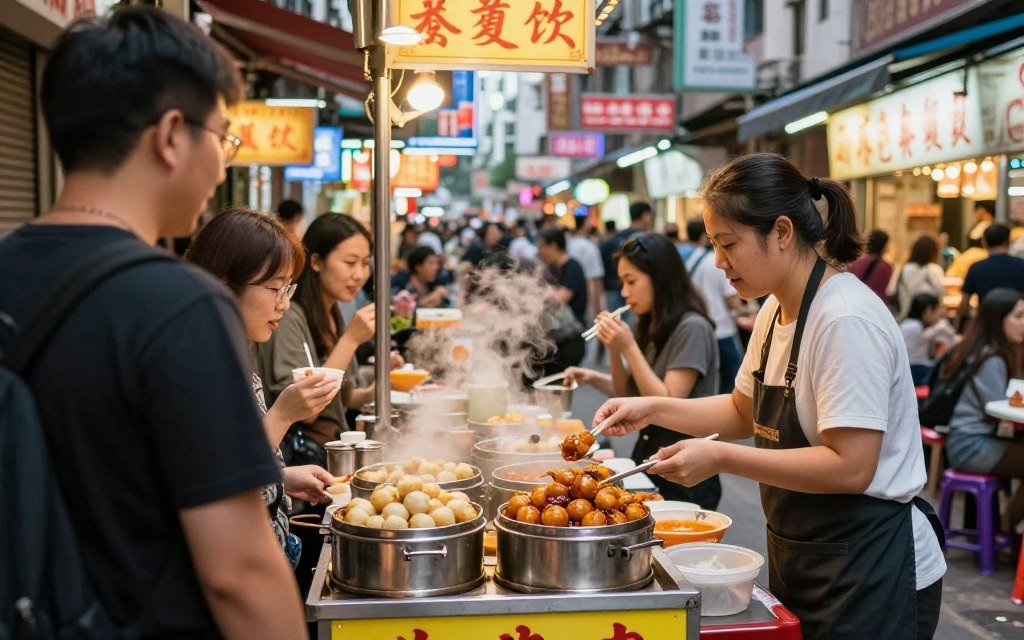
Start your Mong Kok walk with a clear spine—Argyle Street—so you spend less time lost and more time tasting. Use it as your navigation line through the grid. It’s easy to follow and packed with snacks close by.
Argyle Street as your launch point
Argyle works as a spine. From here you can branch north or south without backtracking. That makes it a calm, reliable start if you’re new to the area.
Sai Yeung Choi Street for stall-hopping
Walk a short block to Sai Yeung Choi Street. You’ll find multiple vendors side by side. It’s ideal for quick compare-and-contrast bites.
Yuen Street for curry fish balls and mixed snacks
Drop into Yuen Street for Tung Tat Food Shop and classic curry fish skewers. You’ll also spot dim sum basics and quick BBQ pork snacks nearby.
Pacing tip: have one skewer first, try a sweet snack later, then return for a second savoury bite. If a local queue moves fast, it’s usually a good sign—join in.
| Stop | What you’ll try | Why go |
|---|---|---|
| Argyle Street | Navigation spine | Easy to follow, many options |
| Sai Yeung Choi Street | Multiple stalls | Quick comparisons |
| Yuen Street (Tung Tat) | Curry fish / skewers | Classic curry fish flavours |
Sham Shui Po bites worth the MTR ride
Sham Shui Po rewards a detour with long-running stalls and a cluster of Michelin-recognised places. You’ll find credible, local vendors that show how varied the city’s quick snacks can be. 🍢
Hop Yik Tai: cheong fun and a handy savoury reset
Where: 121 Kweilin Street, Sham Shui Po. Hop Yik Tai is Michelin-recognised for its cheong fun.
Order cheong fun — smooth rice rolls with savoury sauces — as a palate reset between curry bites. Pair it with siu mai for a simple mini combo that balances texture and salt.
Kung Wo Tofu: silky pudding and crunchy deep-fried tofu
Where: 118 Pei Ho Street, Sham Shui Po. Open 7AM–9PM daily.
Try the tofu pudding: light, silky and gently sweet in syrup. If you crave crunch, the deep-fried tofu is golden outside and soft inside — a great contrast to skewers.
- Quick logistics: both places can queue — arrive earlier to skip waits.
- Why go: these stops broaden your tasting map so your fish ball hunt feels complete.
“You’ll find classic, reliable flavours here that round out a proper sampling route.”
| Place | What to order | Why it helps your tour |
|---|---|---|
| Hop Yik Tai | Cheong fun, siu mai | Savoury reset between curry snacks |
| Kung Wo Tofu | Tofu pudding, deep-fried tofu | Light dessert or crunchy contrast |
Fish balls beyond the skewer: noodles, cart noodles and soups
Swap the skewer for a bowl when you want a proper meal that still feels like local snacking. A bowl gives you broth, texture and a sit-down pause without losing the kong street food spirit.
Block-style noodle shops and a 24/7 option
Block 18 Doggie’s Noodle (27-31 Ning Po Street) is open 24 hours. It’s perfect for late-night hunger or jet-lag. Expect springy noodles and a clean fish cake soup bowl that comforts without fuss.
Cart noodles culture made simple
Cart noodles are custom bowls. You choose the noodle type first, then point to 3–5 toppings: fish balls, wontons, veg, offal or shrimp. Finish with sauce level and you’re set.
- When to switch: choose bowls when you want a meal, warmth and a longer sit.
- What to look for: springy noodles, clear broth, toppings that taste of real meat or fish — not filler.
- Pairings: fish balls + wontons for variety, or fish balls + greens for something lighter.
“Point, pick your noodles, choose 3–5 toppings, then tell them the sauce level — easy even without Cantonese.”
| Element | Why it matters | How to order |
|---|---|---|
| Noodle texture | Springy, holds broth | Choose springy or thin |
| Broth | Clean, balanced | Ask for light or rich |
| Toppings | Real flavour, not filler | Pick fish balls, wontons, veg |
What to eat with fish balls for the full street-food experience
Pairing fish balls with the right sides turns a quick snack into a satisfying mini-feast. You’ll taste different textures and balance without over-ordering.
Siu mai dumplings as the classic sidekick
Siu mai is juicy, meaty and quick to eat. Hop Yik Tai is a local favourite for these steamed bites.
If you want a strong savoury hit, start with siu mai. It pairs well with bouncy fish balls and lifts the meaty notes.
Cheong fun rice rolls for something silky and light
Cheong fun is smooth and saucy. It gives your palate a gentle reset after spicy curry.
Go cheong fun first if you’re spice-sensitive or want a lighter counterpoint to fried textures.
Three Stuffed Treasures for a crunchy fish-paste hit
Three stuffed treasures are fish paste wrapped in veg or tofu and pan-fried for crunch. They show off fish paste in a different shape.
They’re perfect if you love fish paste but want a crisp edge and a handheld snack to share.
- Perfect trio: fish balls (bouncy) + siu mai (juicy) + cheong fun (silky) = balanced tasting.
- All three are easy to eat standing up, walking, or sharing with a mate.
- If you want guidance, follow a simple loop: skewer first, dumpling second, rice roll last.
| Item | Texture | Best with |
|---|---|---|
| Fish balls | Bouncy | Curry or light dip |
| Siu mai | Juicy | Beer or soy dip |
| Cheong fun | Silky | Sweet soy or sesame |
“Build a simple trio and you’ll find how complementary textures make each bite shine.”
For more quick routes and local tips, check a handy guide to hong kong street food. Enjoy the walk and the tasting — you’ll find surprises on every block. 🍢
Sweet breaks between savoury snacks
Take a short sweet detour between savoury stops to reset your palate and keep tasting fresh. A sweet bite clears spice and sharpens texture contrasts.
Mammy Pancake — Michelin-recommended egg puffs
What to order: try the classic egg puffs / egg waffles at 8–12 Carnarvon Rd, Tsim Sha Tsui. Aim for a crisp shell and a pillowy centre.
Why it matters: Mammy earned Michelin attention for consistent texture and bright flavour. It’s a reliable reset between curry and chilli.
Master Lowkey Shop — loaded waffle toppings
Expect queues at Shop B3, 76A Shau Kei Wan Main Street East. The wait is worth it if you want toppings like chocolate, ice cream or green tea.
Share one between two. The loaded versions are rich, so go mid-route rather than at the end.
Egg tarts and cha chaan teng baked goods
Pick up a caramel egg tart at Tai On Coffee and Tea (830 Canton Rd, Yau Ma Tei) when you need a grab-and-go treat.
If you want to sit, a cha chaan teng offers air‑con, coffee and simple baked goods. It’s a comfy pause on a hot day.
- Timing tip: sweets mid-run reboot your senses and prevent overload.
- Mobile-first: choose one sweet stop, share, then resume your hong kong hunt.
“A well-placed sweet stop makes the next savoury bite feel brand new.”
| Place | Best buy | Texture / Notes |
|---|---|---|
| Mammy Pancake | Egg waffles | Crisp outside, pillowy inside — Michelin nod |
| Master Lowkey Shop | Loaded waffles | Rich toppings (chocolate, ice cream) — expect queues |
| Tai On Coffee and Tea | Caramel egg tart | Grab-and-go pastry or sit for drinks |
Dai pai dong and cha chaan teng: how locals really eat
Sink into a local rhythm at open-air dai pai setups and cosy cha chaan teng cafés — both tell a real story about how locals eat. These places reveal how the city moves between work, errands and late nights.
Dai pai dong atmosphere and what to expect
Dai pai are open-air, cooked-to-order stalls. They can be cramped, loud and fast. That bustle is part of the charm.
Find them in Central, Sham Shui Po and Jordan. Everyone queues and eats close together — the places are equalisers. Expect quick service, shared tables and strong flavours.
“Sit close, speak softly between bites, and enjoy the unfiltered local rhythm.”
Cha chaan teng comfort eats to pair with street snacks
Cha chaan teng are affordable cafés with classic comfort dishes. They offer tea, simple mains and a calmer place to sit.
Why this matters for your fish ball hunt: after spicy curry skewers or grab-and-go snacks, a hot drink and a cha chaan teng dish will balance the run. It’s a reset for flavour and energy.
- Plain terms: grab-and-go stalls = quick; dai pai = open-air cooked meals; cha chaan teng = café-style comfort.
- Etiquette: tuck bags, order promptly, don’t linger if there’s a queue.
- Where to look: Central, Sham Shui Po, Jordan for that late-night dai pai vibe.
| Spot | Vibe | Best for |
|---|---|---|
| Dai pai stalls | Noisy, communal | Hearty, cooked meals |
| Cha chaan teng | Comfort, calm | Hot drinks and balanced dishes |
| Grab-and-go stalls | Fast, mobile | Skewers and quick snacks |
Try it once. Even if you’re shy, sharing a table or ordering from a dai pai brings a memorable slice of the city. You’ll find warmth, honest cooking and the kind of local routine that makes the place feel lived-in. 🍽️
Markets and night markets for street food variety
Visiting a night market is the quickest way to sample many local classics in a short time. Markets group lots of choices so you and your mates can each pick something different and still share bites. 🍢
Temple Street: quick tasting loop and stinky tofu
Temple Street has a lively food stall area where you can try staples like stinky tofu and hot noodles. Stinky tofu is fermented, then deep‑fried — yes it smells strong, but it’s crisp, savoury and great with sweet chilli sauce.
Tai Po Market: local vibe, easy access
Tai Po Market sits by the MTR and feels less frantic than some central markets. You’ll find seafood vendors, roast goose, snacks and quick sit-down options. It’s a practical stop if you want a more local rhythm.
Cooked food centres: choose and cook
Wong Nai Chung Cooked Food Centre lets you buy fresh seafood and have it wok-fried with garlic, chillies and veg. It’s a nice break from skewers and gives a made-to-order meal experience.
“Markets are perfect when the weather turns — you can slow down, try more and stay dry.”
- Why go: many places in one spot.
- How to taste: make a simple loop — one stall, one skewer, one bowl.
- Tie-in: use markets to compare fish snacks with roast goose and noodles.
| Market | What to try | Access / vibe |
|---|---|---|
| Temple Street | Stinky tofu, hot noodles | Night market, beginner-friendly |
| Tai Po Market | Seafood, roast goose, snacks | MTR link, local pace |
| Wong Nai Chung Centre | Made-to-order seafood | Cooked food centre, sit-down option |
For a broader list of markets and tips, check this night markets guide.
How to do a Hong Kong street food tour when you’re short on time
If you only have a day or two, a guided tasting walk cuts the guesswork and ups the hits.
Old Kowloon Eats-style tours are a compact, local-led option. They run about 4.5 hours through Mong Kok and nearby markets. A guide points out hot stalls, explains ordering cues and keeps the pace relaxed. 🍢
Old Kowloon Eats-style tours through Mong Kok and Sham Shui Po
What it looks like: a small group walk led by a local who knows queues and quiet gems. Expect multiple stops at Michelin-recommended places and little shops you’d miss solo.
What you’ll typically sample: curry fish balls, tofu, buns and more
Typical tastings include curry fish balls, deep-fried tofu, slippery rice rolls, pineapple buns and wonton soup. Over 15 bites are common, so you’ll taste a wide range without hunting each place yourself.
“Go hungry, wear comfy shoes and pace yourself—4.5 hours is a delicious marathon.”
- Is it worth it? Yes if you’ve limited time and want a curated intro to local flavours.
- Cost context: around USD150 per person covers eats, drinks and transport during the tour — a splurge, but it often replaces lunch + dinner.
- Pro tip: do the tour once, then revisit your favourite stall solo the next day.
| Feature | Why it helps | Expectation |
|---|---|---|
| Guided route | Saves research time, finds hidden places | 4.5-hour walk, 15+ tastings |
| Local insight | Queue hacks and ordering cues | Visits Michelin-recommended stalls |
| Cost vs time | Splurge that replaces two meals | ~USD150 all-inclusive |
If you prefer booking a similar local-led option, consider this short list of curated food tour experiences to compare dates and availability.
Practical tips for Aussies: timing, queues and ordering
Timing is your secret weapon: pick the right hour and the city opens up. Afternoons (arvo) mean fewer queues and easier navigation. Late night is prime for noodle shops, markets and the most electric street atmosphere.
When to go
Choose arvo if you want swift stops and room to move. You’ll find quiet stalls and clear walking lines.
Go late if you crave ambience and 24/7 spots like Block 18 Doggie’s Noodle. Markets and night vendors shine then.
Queue etiquette and eating on the go
Queues are an equaliser—join the back and wait your turn. Don’t hover at the front or try to skip in.
- Eating-on-the-go kit: tissues, water, small cash and a napkin.
- Stand slightly off the footpath so you’re not blocking passers-by.
- Share one item at a time with mates to keep tasting more places.
Easy ordering cues: point, pick, pay, repeat
Use this simple script: point → hold up fingers to confirm quantity → pay → collect → step aside. It works at almost every stall.
Start mild if you’re spice-sensitive. Add chilli later and chase heat with something silky like tofu pudding or cheong fun.
“Stay calm, follow the flow and you’ll find the best bites even without Cantonese.”
| Topic | Practical tip | Why it helps |
|---|---|---|
| Best time | Afternoon for quick stops; late-night for markets/noodles | Fewer queues vs peak atmosphere |
| Queue rules | Join the end, don’t hover, no bypassing | Keeps things fair and relaxed |
| Ordering script | Point → fingers (qty) → pay → collect | Simple, fast and language-proof |
Where to stay to be close to the street food action
Base yourself near a bustling hub and you’ll turn snack-hunting into a relaxed daily habit. Pick a suburb that cuts travel time and gives you more tasting minutes each day.
Staying near Mong Kok for maximum stall density
Mong Kok is the easiest first‑timer base. Hundreds of stalls cluster here, so you can hop lanes and compare curry skewers within minutes.
Choose a room near an MTR exit and you’ll repeat favourite spots without fuss. That means more samples and less planning.
Using Sham Shui Po as a base for Michelin‑recommended bites
Sham Shui Po suits travellers chasing authentic, Michelin‑flagged places like Hop Yik Tai and Kung Wo Tofu.
The vibe is more local and quieter at night, so it’s great if you value curated eats over constant bustle.
- Pick one base and run day/evening loops rather than switching hotels.
- Prioritise proximity to MTR exits, late‑night options and walkability.
- Tip: stay curious—walk one street further and you’ll often find the best places.
“Stay near a hub and repeat your favourite curry fish ball stall without re‑planning.”
| Base | Why choose | Best for |
|---|---|---|
| Mong Kok | High stall density, easy comparisons | First-timers, repeat visits |
| Sham Shui Po | Michelin-recommended bites, local vibe | Curated tasting, quieter nights |
| Advice | MTR access & walkability | More snack time, less transit |
Conclusion
Wrap up your tasting day with a simple route that keeps choices tight and flavour comparisons easy. Start in Mong Kok, add Sham Shui Po for the trusted stops, then finish in Jordan or the markets for noodles and night energy.
Must-try: grab curry fish balls first, then compare with a noodle or cart-noodle bowl to hear the differences in texture and sauce.
Visit Tung Tat Food Shop, Hop Yik Tai, Kung Wo Tofu and Temple Street Night Market for a solid cross-section of places to try.
Notice bounce, sauce thickness and spice balance. Save 2–3 pins, keep your route tight, and let queues guide you to the best stalls. Next visit, reuse this framework to chase new snacks — there’s always another street to explore. 😊